


THE SHIFT
Procedures are moving to ASCs and outside the OR. The rescue equipment isn't.
Payers and CMS are moving surgery and sedation out of the hospital ORs.
The patients are older, heavier, and more likely to have sleep apnea.
They're going to sites with no ICU down the hall and no respiratory therapist on call.
+50%
Non-operating room anesthesia (NORA) cases are projected to exceed half of total anesthesia cases in the near future. 2
87%
of US surgeries are ambulatory 1
30 Million
Americans affected by obstructive sleep apnea, with an estimated 80% of cases undiagnosed at the time of procedure. 4
THE RISK
Sedation obstructs the airway, in every patient.
Even patients who breathe fine when asleep at home obstruct under anesthesia.
For the patients now filling ASC schedules - sleep apnea, obesity, heart disease - the margin is thinner still.
50%
Of anesthesia malpractice claims are related to complications from sedation. 5
3.3x
Higher odds that a sleep-apnea patient needs an airway rescue under ambulatory sedation. 6
72%
Share of cardiac arrests during endoscopy sedation that began as airway problems. 7
It's estimated that between $9B and $13B is added to U.S. healthcare spending each year by procedural sedation adverse events - modeled from existing literature on healthcare economics. 8
WHAT PREVENTS IT
Two things work:
Seeing the breathing, and supporting it with positive pressure.
41%
Fewer severe oxygen drops when capnography is added to sedation monitoring. 9
55%
lower odds of cardiovascular complications when sleep apnea patients are on CPAP. 11
25% → 8%
Hypoxia during endoscopy in obese patients when CPAP is applied. 10
Today these come as separate patient interfaces that pair with a monitor and a machine. But the machine is missing from the procedure room and ill-suited to travel with the patient...
We put both in one system, powered by the oxygen outlet.
THE MACHINE-FREE NON-INVASIVE PLATFORM
One system. See it, support it, open it.
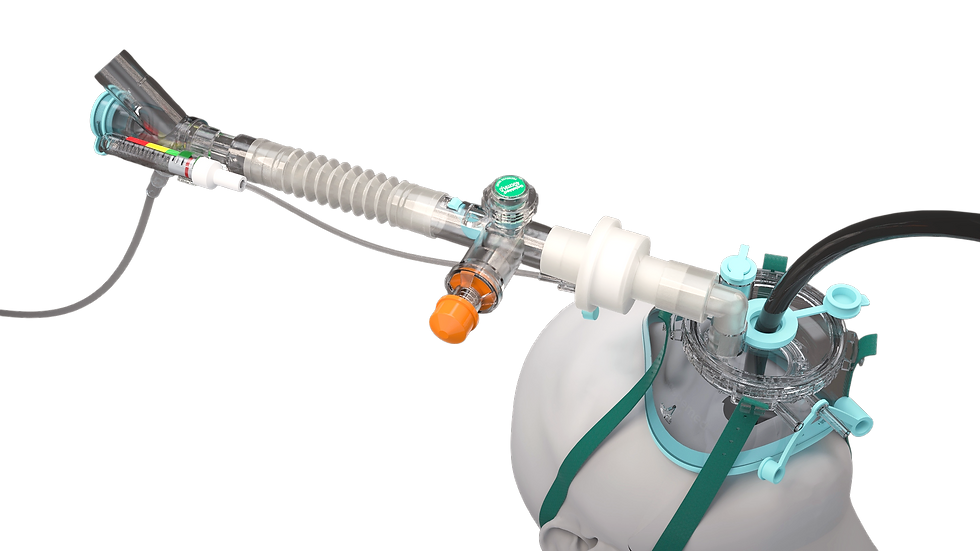
O2rizon
A modular oxygen mask with Circumferential Oxygen Delivery and built‑in EtCO₂ breath monitoring that's
engineered to support the airway without removal of the scope, when oxygen levels drop.
™
™
SlideKick OPA
An adjustable airway fitting delivered through a bite block, with optional oxygen delivery and EtCO₂ breath monitoring layered on top.
™
Ye CPAP
Machine-free CPAP from the medical gas cylinder or wall supply, in any location. From the moment of extubation, through patient transport, perioperative support, or procedural sedation.
Market Opportunity
The global anesthesia and respiratory device market was valued at $50.3B in 2023 and is projected to reach $97.1B by 2033, and the shift toward procedures done outside the traditional operating room is accelerating that growth right where Scopemed lives. 12
$97.1B
Projected global anesthesia & respiratory device market by 2033, up from $50.3B in 2023. 12
21%
Compound annual growth rate of procedures done in ASCs. 13
>50%
Of all anesthesia cases expected to happen outside the operating room within the next decade. 3
North America already leads the category, capturing 41.2% of global revenue in 2025,
and it's where Scopemed is launching first, with initial adoption targeted at settings most exposed to sedation‑related airway risk. 14
-
Tertiary care centers
-
GI Ambulatory Surgery Centers
-
Plastics surgery
Europe follows as the second phase.



Clinical Resources:
-
Friedlander DF, Krimphove MJ, Cole AP, et al. Where is the value in ambulatory versus inpatient surgery? Ann Surg. 2021;273(5):909-916. doi:10.1097/SLA.0000000000003578
-
Beard J, Methangkool E, Angus S, Urman RD, Cole DJ. Consensus recommendations for the safe conduct of nonoperating room anesthesia: a meeting report from the 2022 Stoelting Conference of the Anesthesia Patient Safety Foundation. APSF Newsletter. 2023;38(3). Published October 1, 2023. Accessed October 19, 2026. https://www.apsf.org/article/consensus-recommendations-for-the-safe-conduct-of-nonoperating-room-anesthesia/
-
Herman AD, Jaruzel CB, Lawton S, et al. Morbidity, mortality, and systems safety in non-operating room anesthesia: a narrative review. Br J Anaesth. 2021;127(5):729-744.
-
American Academy of Sleep Medicine. New national indicator report details importance of prompt sleep apnea diagnosis and treatment. Press release. April 4, 2023. Accessed October 19, 2026. https://aasm.org/new-national-indicator-report-details-importance-prompt-sleep-apnea-diagnosis-treatment/
-
Walls JD, Weiss MS. Safety in non-operating room anesthesia (NORA). APSF Newsletter. 2019;34(1). Published June 1, 2019. Accessed October 19, 2026. https://www.apsf.org/article/safety-in-non-operating-room-anesthesia-nora/
-
Ceban F, et al. Adverse events in patients with obstructive sleep apnea undergoing procedural sedation in ambulatory settings: an updated systematic review and meta-analysis. Sleep Med Rev. 2025.
-
Goudra B, Nuzat A, Singh PM, Gouda GB, Carlin A, Manjunath AK. Cardiac arrests in patients undergoing gastrointestinal endoscopy: a retrospective analysis of 73,029 procedures. Saudi J Gastroenterol. 2015;21(6):400-411. doi:10.4103/1319-3767.164202
-
Saunders R, Davis JA, Kranke P, Weissbrod R, Whitaker DK, Lightdale JR. Clinical and economic burden of procedural sedation-related adverse events and their outcomes: analysis from five countries. Ther Clin Risk Manag. 2018;14:393-401. doi:10.2147/TCRM.S154720
-
Saunders R, Struys MMRF, Pollock RF, Mestek M, Lightdale JR. Patient safety during procedural sedation using capnography monitoring: a systematic review and meta-analysis. BMJ Open. 2017;7(6):e013402. doi:10.1136/bmjopen-2016-013402
-
Hünerbein R, et al. Nasal continuous positive airway pressure to reduce hypoxia in patients with obesity undergoing sedated upper gastrointestinal endoscopy: a prospective randomized trial. Clin Gastroenterol Hepatol. 2025.
-
Benjafield AV, Pépin JL, Cistulli PA, et al. Positive airway pressure therapy and all-cause and cardiovascular mortality in people with obstructive sleep apnoea: a systematic review and meta-analysis of randomised controlled trials and confounder-adjusted, non-randomised controlled studies. Lancet Respir Med. 2025.
-
Market.us. Anesthesia and respiratory devices market. Published April 2024. Accessed October 19, 2026. https://market.us/report/anesthesia-and-respiratory-devices-market/
-
Sg2. 2024 Impact of Change Forecast: ambulatory surgery center volume. Cited via Periop Leader. Published July 2024. https://www.sg2.com/press-releases/sg2-projects-continued-constraints-for-patient-access-to-care
-
Grand View Research. General anesthesia drugs market size, share & trends analysis report. Published September 2026. Accessed October 19, 2026. https://www.grandviewresearch.com/industry-analysis/general-anesthesia-drugs-market-report
-
† Bench data; may not reflect clinical performance. Internal engineering estimate for the combined SlideKick™ OPA + O2rizon™ rescue pathway, based on bench testing and not yet substantiated by clinical outcomes data. Data on file, [record number from Regulatory]. O2rizon™, SlideKick™ OPA, and the Ye Circuit are in development and are not available for sale in the United States.